Picking Cotton – Cotton Patch

When cotton blooms fall off the plants, little leafy squares form, and they, in turn, grow into egg-shaped green bolls that hold the tight, wet cotton fibers inside. As the bolls mature, the hot sun performs one of nature’s wondrous works. The wet cotton inside its neat little package gradually dries out, becoming fluffier and fluffier until it bursts the shell and pops out into long white strands. In the days of manual labor, a field was ready for the first picking when about one-third to one-half of the bolls were open.

The main piece of equipment for a cotton picker was a long sack made of heavy ducking or canvas material. For the adults, there were sacks six to seven feet long, and for the younger ones, the sacks were three to five feet long. Each sack had a strap that went around one side of the neck and under the opposite arm. The opening hung loosely under the arm to make it accessible for receiving the handfuls of cotton. One might choose to wear gloves and knee pads, but long sleeved shirts and wide-brimmed hats were necessities.

Hats offered protection from the hot sun and the long sleeves helped protect the arms from scrapes and scratches from rough stalks, briars and sharp points of the drying out bolls. The long sleeves might also protect one against an unseen “stinging worm”, a vicious little critter that was the same shade of green as the leaves on which they liked to hide. These worms were two to three inches long and had many hair-like stingers, each of which was capable of raising a red whelp on one’s skin. I don’t recall being stung many times, but the dread of being stung was part of the job.

I have no memories of my mother picking cotton, but I have been told that she would set me on her cotton sack and pull me along as she picked her way down the rows. It was a rather common sight to see parents or older siblings pulling a young child on the sack. Sometimes it was for entertainment, but often it was out of necessity.

When the cotton is white and fluffy in the bolls, it needs to be picked before the rain can beat down upon it and ruin it, so every available hand in the family was expected to help. Often farmers needed extra hands and would pay between 75 cents and $2.25 per hundred pounds of picked cotton. My average day was in the range of 100 to 150 pounds, which at $2.00 per hundred would make my day’s wages come to only 2 or 3 dollars! Today that sounds outrageous, but remember, one could buy a coke, a candy bar or a package of gum for a nickel in those days.

I had an elderly aunt who picked an unbelievable amount of cotton in a day’s time. I want to say that she could pick in excess of 500 pounds, but I was so impressed that my memory may have embellished the number a little. I was young and able-bodied and could barely pick 150 pounds, and here was this frail-bodied woman who could pick three to four times as much as I could. It was incredible, but it was not nearly as humiliating as the fact that my brother, who is three years younger than I, always beat me by weighing out about 200 pounds a day. That ought not to be.

One day I was determined to pick 200 pounds, and I worked relentlessly to reach that goal. We were working for a gentle, easy-going uncle, who continued to encourage me during the day. At the last weigh-in, the scales balanced at the right spot and I was elated. I had reached my goal but I was too tired to look forward to the County Fair that we had planned to attend that night.

Bathing must have been minimal that evening in preparation for the fair because I remember walking among all the jovial people knowing that my hair was stringy and dirty and that my face was sunburned. I was too tired to do much, and I had worked so hard for my money I didn’t want to let go of it. I had learned an important lesson in the real cost of things.

I have no particular memories of picking 200 pounds ever again. Characteristically, I have worked more slowly than other people with whom I have worked side by side in many situations. While this could have been interpreted as laziness, it was not my intention.


Having to work hard for one’s spending money is probably the quickest way of learning the value of money and what it costs to have the things we desire. Our values or priorities can change when faced with the reality of earning our way.

The Power of One Person – Holocaust Museum

HOLOCAUST MUSEUM AND LEARNING CENTER 

ST. LOUIS, MISSOURI

My husband has a doctor in St. Louis, Dr. Simon Yu. Recently he had a lengthy visit with a procedure.  After our lunch break  I had two hours to spend in St. Louis. I decided to Google things to do near me and Google came through with several suggestions.  I found the Holocaust Museum was in walking distance of Dr. Yu’s office.  My youngest daughter and I went to the Museum. She was a bit reluctant. I feel like it is important for us to study the Holocaust and other times in history even though it is uncomfortable and unpleasant at times.

Fear

As we neared the entrance to the building I noticed a sign near the door about new security features. Isn’t it sad that we still have to fear those who will enter our doors to mistreat or kill us? They let us enter and were very gracious and appreciative of our coming to the museum.

How the Museum Came to Be

Our first stop told how the museum came to be. The museum was in memory of Gloria M. Goldstein who’s husband had made great contributions to establish the museum.. In 1977 a Center for Holocaust studies was established as a living memorial to the 6 million Jews who perished in the Holocaust. Many Jews had settled in this area during and after the war.

According to the brochure, “Provocative speakers drew Holocaust survivors who had settled in the St. Louis area. They were invited to share their oral history and experiences with schools, churches, and other organizations. They became the teachers and as they shared their stories people listened, asked questions and learned the horrific lessons of the Holocaust. The Oral History project enabled the center to interview and preserve the testimonies of the survivors, liberators of Nazi concentration camps, non-Jews and all those who were impacted by World War II.”

We chose to do the self guided tour although there are guided tours available. We found out that all of the artifacts had a direct connection to people in St. Louis. As we walked through the exhibit we stopped to watch footage, read exhibits, and look at artifacts and photos from World War II and the concentration camps. No one was laughing and talking as they visited this museum.

Estimated 11 Million Lost Lives

Over 6 million Jews lost their lives as they were targeted by Hitler’s genocide. We learned that many non-Jews, maybe as many as 5 million also lost their lives. We learned about the different Star designations that betrayed obvious prejudice and hatred. The horror of women being ripped from their families, having their heads shaved and all their possessions taken, even family photos. They were allowed to keep their shoes. There were so many little details that my study of WWII in the past had omitted.

The Power of One Person

One part of the display stands out to me and that is the power of one person. Individuals who chose to risk their lives to care, defend and save the lives of others while risking their own lives. Stories of those who had hidden children and families to rescue them and help them escape death. One lady is thought to have rescued thousands of children. I am fascinated with these stories and I hope that I would have been willing to risk my life if I had lived during this time period!

Make A Difference in Your World

Regardless of what your government or anyone else does you can still do right. You can still make a huge difference in the world. Impacting one life is a beautiful thing. Don’t let this kind of horror happen again. Go out and make your world a better place. Be the change you want to see in the world!

God Bless You!  

Reda

Mural at the Holocaust Museum - St. Louis
Mural at the Holocaust Museum – St. Louis
Reda and Esther visit the Holocaust Museum

Visit:

Holocaust Museum and Learning Center

12 Millstone Campus Dr, St. Louis, MO 63146 

(314) 442-3711

According to the website the museum is open Monday through Thursday 9:30 a.m. to 4:30 p.m., Friday 9:30 a.m. to 4 p.m., and Sunday 10 a.m. to 4 p.m. Docent-led tours by appointment. The museum is a department of Jewish Federation of St. Louis. Fran Poger is Chairperson.

Camping at Savage Gulf

A new adventure! Friday morning I left home with a group of 14 (10 teens and 4 adults) from church to travel 93 miles to Savage Gulf State Natural Area. We set up our camp at # 4 Group site. With hammocks hung and tents assembled we were ready for some fun before dinner.

Some of us decided to explore the falls while some stayed behind to play games. The hike to the falls started at the Ranger station. About 300 yards from our campsite was the Ranger station, so we had an easy time of it! It was 1.5 mile hike to the falls from the Ranger station.  One plus to having the Ranger station nearby was that it has flushable toilets!

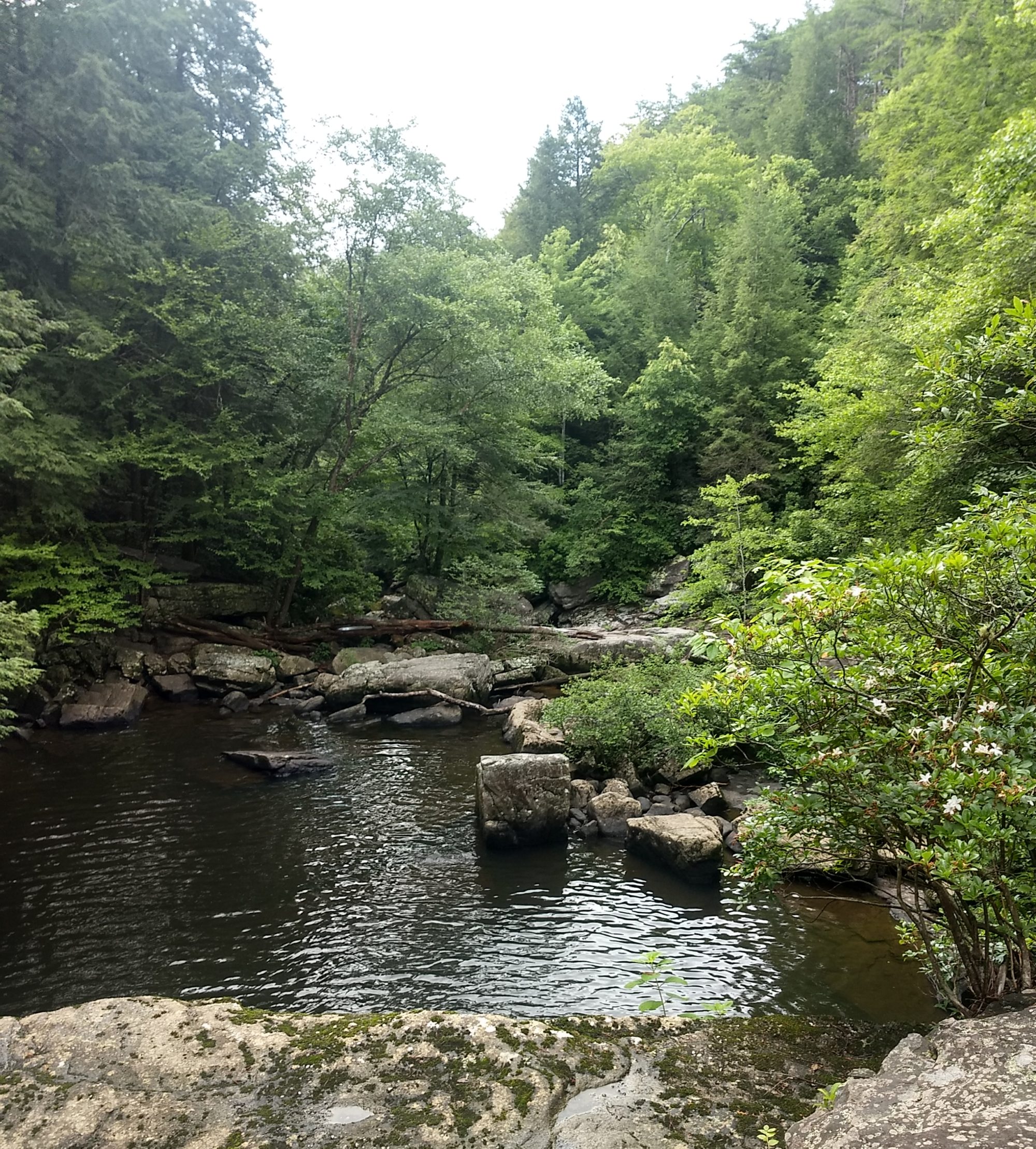
We crossed two suspension bridges on our way to the falls which were really cool. The hike was fairly easy. It was very humid but as we neared the falls the air got cooler and cooler. There were pools that ran over huge rocks. The kids stopped and climbed down the rocks to play in the pools.

Peeking through some giant honeysuckles I could see the pool but not the falls. We stood on the top of the giant rocks and looked over into a larger pool. I walked on down the path to the bottom of the falls where the water cascaded over the rocks from above and dropped into a beautiful pool surrounded by natural rock walls.  As I was watching my son climbed around on the giant rocks surrounding the pool. It was beautiful! It was a fun place to climb around. Then I climbed back up the steps. Those steps were the hardest part of the hike for me. Getting my breath I started the 1.5 mile hike back to camp.

The next morning we decided to leave camp at 8 am to hike to the falls again with our whole group. It was actually much more humid than the evening before. Trees which must have blown over in the recent storms were uprooted and fallen along the path. A deer silently watched us from amid the trees. Crossing the suspension bridges took a bit longer with a larger group. We crossed two at a time stopping in the middle to look at the stream before stepping on to the end. When we had all crossed we continued on down the trail toward the falls.

No one was in sight when we arrived at the falls. It was very still and beautiful. The pool was shadowed because of the time of day but soon the sun reached us from between the high canopy of trees. Everyone decided to go swimming. There are too many huge rocks beneath the surface to allow jumping or diving but there were plenty of places to swim and play in the water. The group had a great time climbing around and standing beneath the water fall to get a shower. We explored the rocks and swam for a couple of hours and then headed toward our campsite.

As we started the return hike we met several groups out for a day hike. There were several family groups with young and old hikers. One group was 11 ladies, old college friends, who meet-up every year for a reunion. Everyone on the trail was friendly to our group. By the time we arrived at the Ranger station we were all hot and sweaty and ready for the bathroom and some water.


I had fun hiking in Tennessee!


My Journey to Malawi

Malawi Young women receiving hygiene bags with great joy.
Young women receiving hygiene bags with great joy.
Billiwiri Church of Christ - Malawi
Billiwiri Church of Christ

My journey to Malawi was an amazing experience! My husband and I spent two weeks traveling and teaching in Malawi. It was the most wonderful ministry experience of my life!

What did we pack for Malawi?

It took a lot of planning and decision making to get ready for our trip. Every day I watched the airlines for tickets so that when the price dropped I was quickly able to purchase our tickets.

We packed and repacked to keep our bag within the weight limit. How could we make the best use of our bag space? What would we take with us? We had some direction from our friends in Malawi about what we should bring. Missionary friends who had gone to Africa also shared ideas with us. Lawrence and I were each allowed a carryon bag, a personal item and one 50 lb. checked bag. What did we carry in our bags? Our personal item was our laptop and lessons. In our carry on bags we packed our clothing. We packed gifts, teaching materials, soccer balls, hygiene bags, protein bars, sheets, and mosquito netting in our checked luggage.

What did we teach?

For weeks Lawrence and I prepared for our lessons. You see Lawrence had been teaching World Bible School lessons for about a year and having a great response from his students. Our contact in Malawi asked us to come and see the work first hand. We were very excited to make this trip.

As we prepared our lessons, I discovered a lot of my teaching was very Americanized. I did not realize how much of my culture was infused in my Bible teaching. Even though I tried to be aware of this I still found surprises.

Having never been to Africa I wasn’t exactly sure what to expect or who my audience would be. Each day I had several opportunities for teaching so I had to be ready to teach at any moment. I did not know when I would be teaching or whom I would be teaching.

Colossians 3 was the text I chose that would apply to everyone. I talked about things we as Christians need to rid from our lives and things we need to incorporate. Starting with these paper dolls pictured below I made a book with the pictures of African women clothed in native attire.

We studied about clothing ourselves with compassion, kindness, humility, gentleness, and patience. Each page featured one of these topics and had a pull out section with scriptures which we discussed. Many years ago I used a flip chart of the Gospel Presentation that I took with me to Africa and used many times. I was so thankful for the preparation I had done. Our brethren have very little in the way of possessions.  Few Bibles, teaching materials, binders, office or craft supplies, etc. So I left almost everything I took with me with our Christian brothers and sisters.

Where did we teach?

We taught in prisons, churches, beside the road under trees, in small little rooms full of children and out back behind church buildings.

In the prison my work was a bit different. Being the only woman in our party, I was taken alone with a female guard back through the prison to the women’s section to teach. The number of women inmates was much less than the number of men.  My largest number of inmates was 10 as compared to 500+ men inmates that my husband and other preachers were teaching. Sometimes I would teach outside in a courtyard or in a room. My students were inmates and guards. These students were eager for teaching and were very happy to sit for long periods of time to hear the Bible.

There were very few Bibles therefore I carried an extra Bible in my pack in Chichewa so that they could read the verses in their language. Most of my students knew some English. If asked what their greatest need is they would probably say Bibles. Sometimes they would sing for me and it was indeed a huge blessing to hear their lovely voices.

In one location 500 inmates were sharing two Bibles. The ladies section at that same prison had 1 Bible and a part of a Bible which was well used and they shared with one another. It was obvious they loved the word and wanted to learn more.

Results of our teaching in Malawi.

I saw many people obey the gospel. They were baptized in streams, in church and prison baptistries, and in portable baptistries as a result of our teaching and the teaching of our brothers in Malawi. One day we had to travel about 20 miles to find enough water to baptize. On another day I saw 32 obey the gospel. After my return several of the women I taught continued to study World Bible School and obeyed the gospel. One of my sweet guards wrote and thanked us for showing her the way. I am able to communicate occasionally with her through Whatsapp and continue to share studies from the Bible with her.

What did we eat?

We were in Malawi during a time when there seemed to be plenty of food. As we traveled along the roads or through the markets we would see produce stacked in pyramid shapes for sale. However, the natives did not eat three times a day as Americans are accustomed to doing. Nor did they eat the amount of food we eat.

For breakfast we had eggs (fried, boiled, etc), potatoes, toast, omelets, hot tea, coffee. At our second meal we ate chicken, goat, eggs, tomatoes, onions potatoes, rice, nsima, and pasta. There was a bit of fruit available in the markets and English biscuits that we purchased to keep with us. Every day we had to purchase water. I purchased “sweets” to share with the village children and many times the adults too.

Sometimes we would go all day without stopping for a meal so the snacks we had packed helped hold us over until dinner. We shared the snacks we brought from home with our traveling companions. These snacks were new to our friends and they enjoyed them very much! They especially liked the tuna pouches.

We are going again!

After coming back to the states it was very hard to go back to normal. We left so much of our hearts in Malawi. The students studying through World Bible School continue to increase and many obey the gospel every month. We are working for and with Malawi on a daily basis. We are excited to begin planning our return trip this September to Malawi.

Let Me Share My Story with You.

There is so much more that I could share. I would love to share my story about the work in Malawi. If you have questions about our trip or the work we do in Malawi please just ask. I would love to talk about it!!

If you would like to help with the work I can tell you how to do that too! If you know someone you think would like to hear about our work please share our contact information. My husband would be happy to come and talk with your church or eldership.

Invite me to speak to your ladies group or organization.  redaredding@gmail.com

Smyrna Church of Christ

Malawi Missions

P.O. Box 314

Smyrna, Tn 37167


Samson's village - Malawi
Samson’s village – Malawi
Watson and Family - Malawi
Watson and Family – Malawi
Teaching beside the road in Kasunga - Malawi
Teaching beside the road in Kasunga – Malawi
Kasunga
Babies go to prison with their mothers
Meeting some WBS students
Twins
Another village
Cecilia one of the guards who later became a Christian
Muya Tembo’s village
Tutorial-we brought snacks and soccer balls
Gift of soccer balls
Baptism in the stream
Charles’ village


Prejudice – Cotton Patch

The hard labor that characterized the daily routine of slaves, was often relieved by the singing of songs that revealed their inner struggles. Many of these songs, that we also loved and sang, described the bleakness and harshness of their lives, but most of them revealed hope in something better to come.

As we sang, we didn’t realize the significance of such songs as “Carry Me Back to Ole Virginny”, “Old Folks at Home”, and “My Old Kentucky Home” which speak about longings to be reunited with families that slavery had separated. Neither could we feel the pain that inspired such songs as “Uncle Ned”, “Massa’s in the Cold Ground”, and “Ole Black Joe.” According to the words of the song, ‘Ned’ was a good, hard worker who had died and was going to be sorely missed by his ‘Massa’. The sad feelings experienced by slaves at the death of a kind and gentle master are verbalized in the song about Massa in the cold ground, and ‘Joe’ describes how the vigor that he felt in his younger days has turned to sadness because so many of his family and friends have died and he is left all alone. He ‘hears’ them gently calling to him, and his desire is contained in the words, “I’m coming, I’m coming , for my head is bending low; I hear the gentle voices calling, “Old Black Joe.”

Besides the sad, everyday work songs, there were the sometimes mournful, sometimes lively, Negro Spirituals. My favorite was “Swing Low, Sweet Chariot” in which the singers dream of a band of angels and a chariot coming to carry them over ‘Jordan’ where friends who have gone before await them.

A rather peppy, joyful sounding Negro Spiritual is “Oh, Dem Golden Slippers.” Looking forward to wearing golden slippers refers to the happiness and beauty in heaven, but it also speaks of a deprived existence here on earth. I heard more of the hope and joy that the songs exhibited than I heard of the painful situations from which the people were longing to escape.

As children, we did not ‘see’ the inequities of slavery or of the living conditions common to black people after they were set free. We were unaware of the fact that slaves were not allowed to be educated, and that when they were later granted the right to pursue an education, they were not privileged to use the same facilities with white children. Their schools were substandard for many years until segregation was forced upon the white communities in the 1950’s, almost a hundred years after the Civil War! Even our “Christian” colleges had not taken the initiative to right the wrongs done to their fellow human beings. There were no black students at FHC when I was there in the late 40’s; they were not allowed!

It now seems ironic that Christians did not understand what they were doing; it demonstrates what a stronghold common beliefs and attitudes of a community can have upon those who belong to it. The evidences of that influence upon good people was all around me as I was growing up, and for several years I was simply apathetic. That was the way it was, and I felt no need to challenge it.

A little black lady in the Piney Chapel community lived all alone in a remote field on our neighbor’s farm. She evidently had been allowed to remain in the little house where her family had lived as slaves, and she grew old there. She had an apple tree in her yard, and it was rumored that she had given people permission to get some of the apples, but when I accompanied one of my sisters and some neighbor children to take advantage of her offer, she was not so pleased. It was rather frightening to my six-year-old mind when she hobbled with the aid of a cane out of her house, yelling as she came. Her anger, however, was due to the fact that we had picked apples off the tree rather than having gotten the fallen ones from the ground!

The prejudicial attitudes that existed in Alabama in those days had resulted in all-white rural communities, and the few black people who were allowed to live in a city, huddled together in its most impoverished sections. It was in just such an area in Athens, that my grandfather’s hired man, Will, lived.

Will came early every morning, worked all day and walked home each evening after his work was done. While everyone else ate lunch in the dining room, Will always ate sitting on the edge of the porch or in the kitchen depending on the weather.

Many lines of demarcation had been established, so when another black man came occasionally to pick cotton, it must have been unacceptable for me to admire him, but admire him I did. He sometimes sang as he worked and his voice seemed to me to be right out of heaven! I don’t even remember his name, but I remember having asked him more than once to sing as we worked side by side at the same kind of job under the same hot Alabama sun, now made more bearable by the music pouring forth from this poor man’s soul. My recognition of something great in this lowly being may have been the beginning of the end of whatever prejudice I had acquired from my community.


As we seriously look at what happened in the minds and hearts of many honest, God-fearing people during the troublesome times of slavery, we must continue to examine ourselves for similar delusions that rob us of our abilities to know right from wrong.

Our Visit to Crater Lake

May 20, 2019

After 30 + years we returned to Crater Lake. Its beauty did not disappoint! It has to be one of the most beautiful places in the world. God has created an amazingly beautiful world and this is just one little tiny portion of it! How blessed I am to have seen this beautiful part of the world. Praise God! And do you know we could have so easily missed the opportunity.? This was not in our plan (not that we have very detailed plans usually anyway). We were already in Oregon and Lawrence said let’s go by Crater Lake! We checked distance, cost, weather, etc. and we jumped on the opportunity. So many of the wonderful things I have experienced in my life were not scheduled or planned they were seized. I’m glad I have learned a tiny bit to turn loose and experience the unplanned joys along the way. Of course, marrying a rambling man helped.
Please share an experience that you didn’t plan for but turned into something wonderful!

Did you know that Crater Lake is the deepest lake in the United States and one of the most beautiful? It is surrounded by cliffs and fed entirely by rain and snow. It snowed the night before our visit and the road from the north entrance was closed. (website).

This trip really made me want to get a great camera. Cell phone pictures just don’t capture the glory!

Esther and Reda - Crater Lake
Esther and Reda – Crater Lake
Esther - Crater Lake
Esther – Crater Lake
Lawrence and Reda - Crater Lake
Lawrence and Reda – Crater Lake
 Crater Lake
Crater Lake
 Crater Lake
Crater Lake
 Crater Lake
Crater Lake
 Crater Lake
Crater Lake
Snow in May - Crater Lake
Snow in May – Crater Lake
 Crater Lake
Crater Lake


Marshall Keeble – Cotton Patch

The prejudice that presented its ugly head in the lives of Southern people was not unique to those who were reprobates. As a learned tradition, it etched its way into the hearts of many family members who professed Christianity and who should have known better. I take some comfort, however, in the fact that their behaviors often conflicted with their spoken denouncements.

My Dad occasionally made racial remarks that were not becoming to his position as an educator and certainly not to his profession as a Christian minister. On the other hand, when someone had a need that Dad knew about, prejudice did not enter into his decision…he did whatever he could without hesitation.

In the forties and fifties, a black minister of the gospel won the hearts of many Christian people, and even though he has been dead for several years, his name and work are still alive. He succeeded in getting the support of several well known white brethren to help him establish a preacher training school for young men of his race, and Southern Bible Institute in Dallas, Texas continues to fulfill Marshall Keeble’s dream.

Once, Dad took the family to a neighboring town to hear Brother Keeble in a tent meeting. Brother Keeble, who was known for his use of humor in making important points, sometimes exploded a laugh through half-closed lips. My brother, who happened to be sitting on the front row that evening, declared that he saw a rainbow in the moisture that sprayed from Brother Keeble’s mouth during one of his witty outbursts!

Later, around 1953, my husband and I were privileged to take our small family to an outdoor meeting in Abilene, Texas in which Brother Keeble and some of his student preachers spoke. I am glad that prejudice did not do its dirty work and rob me of these two special experiences.

When I was teaching school, I discovered and read two wonderful books about African Americans to my students. One book, Amos Fortune, Free Man, was about a slave who was given his freedom when he was still a young man, and he spent the rest of his life buying freedom for others. The other book was a biography of George Washington Carver. I never tire of reading about his numerous talents and his unpretentious way of life.

From musician to botanist, to chemist, to artist, to sports doctor, to educator, Mr. Carver credited all of his talents to God. This man, who recognized God as the source of all his talents,….how could anyone suggest that he did not have a soul?

One of Dad’s sisters married the son of a German immigrant, who owned and operated a meat market in Athens, Alabama. Aunt Alma and Uncle Carl were respectable citizens of their communities. She taught in the public school system for many years and later in a private Christian school. I did not have as much contact with them and their children as with the relatives who lived a more rural lifestyle, but the times that we were together made good memories.

During World War II when Hitler began pouring out his terrible wrath upon Jews and others, people in the US identified all Germans with the detestable dictator and Nazism. The prejudice that resulted from this unfair way of thinking made it very difficult for innocent Americanized Germans, and it was particularly hard on their children who had to attend public schools and be subjected to the spiteful remarks that targeted all Germans.

Prejudice can exist between races, between sexes, between rich and poor, between young and old, between educated and uneducated, and it can extend in both directions. Although the cotton patch had a great potential for equalizing all who worked in it side by side, it did not always succeed, and there was also prejudice between those who worked in the fields and those who wouldn’t.

I have witnessed a great improvement in the attitudes of those close to me toward others who are different, and I pray that it will continue to be so.


Prejudice can rob us of having some rewarding relationships, and making generalizations is a form of prejudice totally unfair to those in the group who have done nothing wrong. Give honor to whom honor is due, whoever they happen to be.

Prayer Triggers and Routines

 I want to share a few triggers or routines. Some are ones that help me and might help you with your prayer life. I believe in prayer. I believe that through prayer God can and does show his power and strength in our lives. He gives help and comfort and direction. So why is it hard to take the time to pray? I’m not sure what the answer is to that question. I know that many of you have ideas and I hope you will share those with me in the comments below. I treasure your comments.

Here is a list of prayer triggers and routines which you may find helpful. Remember that we are better together.

1. Passwords

A friend and I are working on a prayer class for the fall. As we were meeting to discuss this class we found out that we both do this with our passwords.

You may use your passwords for triggers. My work prompts me to change my password frequently. I use my passwords to remind me to pray for special people in my life. So every time I log in I can say a prayer for that person.

At first, it was a little hard trying to think of different things I might want to pray for my loved one. I pray for faith, love for God’s word, wisdom, peace, comfort, specific struggles, success in their work, for God to show himself to them specifically that day, I pray for God’s protection, for God to keep them from the evil one, etc. After a while, I kind of got a little excited when I got to sit down at my computer and bring my loved one before God. Surprise! It did get a little bit easier.

2. Calendar

Calendar reminders write the person you want to pray for on your calendar or set daily cell phone alarms to remind you to pray for a specific person perhaps for a specified time.

3. Jenga Blocks

One of my kid’s Bible classes gave the kids Jenga blocks with a person’s name on it to pray for. I love this. Whenever it surfaces in their room they remember to pray for this person. Or some might possibly put it on their shelves to glance at frequently and pray for that person.

4. Tasks

Tasks that I can use as triggers for prayer.

Ironing. Praying for my husband while ironing his shirts makes the task go so much faster and blesses my husband.

Dishes. Thankfulness for food and running water to wash them in. Remember to pray for the hungry.

Laundry – clothes, washing machine.

Buying groceries.

5. Develop the habit of praying with your daily schedule.

Upon rising pray. At lunchtime pray. Dinner prayer of thankfulness for the day we have had and the food we have regularly before us. Bedtime prayers are when my husband and I pray for our children.


6. Memory

Do you occasionally have someone come to mind that you have not thought about it for a long time? Perhaps a childhood friend? A relative? I have had this happen a lot through the years and I try to pray for these people. No, I have no idea what is going on in their lives but I lift them in prayer. Maybe it is someone who has passed from this life, then I thank God for the influence and blessing they were in my life.

7. Emails

Smyrna Church of Christ sends out Emails – reminders to pray for those with health concerns or loss of loved ones, etc.

8. When someone is struggling and asks you to pray.

Pray right then with them. When someone is sick or ask they ask me to pray for them. Pray right then or you might forget.

9. Facebook

Facebook can give us a reminder to pray. When you get angry at something you see, pray, when you see your friends baby growing pray for that child to continue to grow strong and healthy and to grow up to know God. When they lose jobs, family members, etc. Pray. When something wonderful happens to your friend, rejoice with them.

10. Have a Daily Commute?

Pray yourself to work instead of shouting at bad drivers. Pray yourself home and leave the day’s struggles with God so that you can go home and enjoy your loved ones. Listening to an audio of the Bible and also praise music lifts and feeds the spirit.

11. Salvation Bracelets – Made of colorful beads

Black- my sin

Red – the blood of Christ

Blue-baptism washes my sins away

White-forgiven

Green-growth

knot- no separation

Gold-eternal life

12. Other jewelry pieces

Other jewelry pieces may also be reminders of things we would like to pray about. Tree of Life necklace might remind you to ask God to keep you on the path to heaven.

13. Gifts

I have friends who have “the gift” of gift-giving. I wish I was better about this myself so I really appreciate those who have it.

Use those gifts as reminders to pray for the special people in your life. Thank God for those special friends.

Gifts that I have done this with…

vans

baskets

makeup eraser

rug

towel sets

dresses

jewelry

dishes (Betty bowls)

14. Shoes

When you are putting on your shoes remember you are saved to serve. Ask God to help you be a light where-ever you are planted.

15. My faults

When I feel impatient with someone I can use that opportunity to pray about my own faults. We all have them.

16. Struggling with someone in your life. Try praying for them.

I hope that you find these prayer triggers and routines helpful in your life.

Reda’s Jewelry

In March I started selling jewelry with Premier. Premier is a great company that gives back in so many ways. With Premier I have the freedom to earn money and spend more time in Malawi serving the people there. If you are interested in some cool jewelry, a part time job, or mission work in Malawi just private message me. Check out our Redding Mission Trips page on Facebook.
In the meantime please like my Facebook page (Reda’s Jewelry)

Are you looking for gifts for Mother’s Day, Graduation, Birthday, or just something new? Please consider shopping with me and check out my catalog at:
https://www.premierdesigns.com/redaredding
Thanks for your encouragement and support.

Made by God

What amazing gifts I see daily in the spring!  As Phillip Keller said, “Whenever I am afield or outdoors, there steals over me the acute consciousness that I am confronted on every hand by the superb workmanship of my Father. It is as if every tree, rock, river, flower, mountain, bird, or blade of grass had stamped upon it the indelible label, Made by God.” I agree!